Sign in
 Registration


What to bear in mind when buying your first Japanese knife.
Buying a knife should be based on a rational reason. It’s fair to admit that this isn’t always the case. We know this only too well. But let’s assume for the sake of argument that we really do need a new knife.
The fundamental question is: am I looking for a knife with the best cutting performance, or a versatile ‘multi-purpose’ all-in-one tool? If the correct answer is the second part of the question, forget about a Japanese knife. It would be a waste of money.
Since we’re interested in cutting performance, the choice is crystal clear. But what exactly is cutting performance? The answer is surprisingly simple. It’s precisely what makes a knife a good knife: its sharpness, the longevity of its edge, and its ability to regain that sharpness. And Japanese knives absolutely dominate in these areas. There are knives that will amaze you with their sharpness straight out of the box. However, they lose this sharpness quickly, and you won’t be able to restore it using standard methods. Never mind – they’ll do just fine for cutting weeds in the garden.
The preparation of Japanese dishes places great emphasis on the perfect cut. The design, geometry and, of course, the material composition of the knife all play a part in this. Let’s talk about this in more detail.
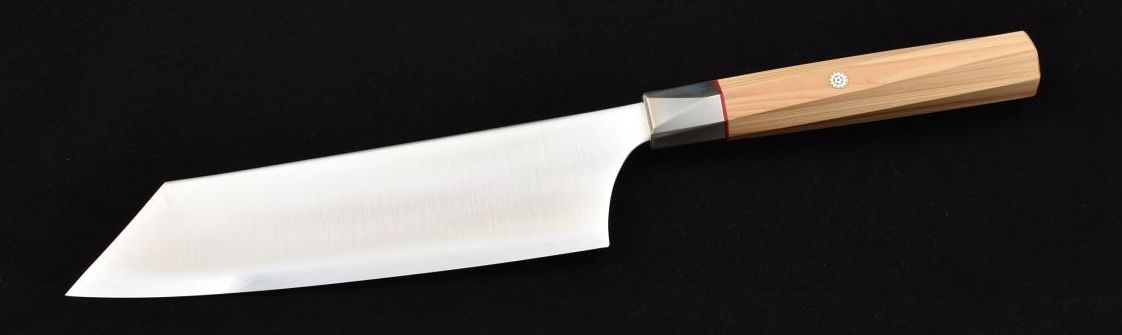
Construction – the typical Japanese half-tang construction makes the knife a feather-light tool. There’s no point in remarking: ‘How can it be so light, yet so expensive?’ Lightweight construction is a hallmark of Japanese knives. They allow for long, intensive use whilst remaining effortless to handle. What’s more, you’ll have significantly better control over it when making delicate cuts. A chef’s knife with a 21 cm blade typically weighs around 150 g – something that non-Japanese competitors can only dream of.
Geometry – apart from the minimal curvature of the cutting edge, it is primarily a question of the type and angles of the grind. There are, of course, many of these, but let us simply state that the angle values are significantly lower than their European counterparts. Japanese symmetrical angles of around 15° provide a high degree of sharpness. Professional single-sided grinds are already reminiscent of razor blades.
Material – low cutting angle values are only useful in very hard materials. The small mass of the steel must withstand the abrasion caused by cutting. If the material is not hard enough, you will lose the edge very quickly. Although hardness is important, high-quality steel must also meet other criteria. Strength, toughness and a fine grain structure all influence the quality of the knife. The ‘Holy Grail’ in the form of absolutely ideal steel does not exist, but Japanese steels are clearly preferred in cutlery. The emphasis is primarily on wear resistance and a fine grain structure; therefore, use a Japanese knife exclusively for cutting food and do not use it for anything else (chopping, prying, opening packaging, cutting bones, frozen products, etc.). The most traditional materials are characterised by high hardness combined with excellent sharpenability. However, this comes at the cost of a tendency to oxidise, which means the knife requires extra care.
 Now that we know what makes a Japanese knife stand out, let’s go and buy one. It sounds simple, but to ensure you don’t end up just cutting weeds, a little caution and sound judgement are certainly called for. If this is your first Japanese knife, it’s understandable that you’re only just beginning to find your feet in this area. The seller should be your first line of defence in ensuring you make the right purchase. It’s not easy to find objective information about overseas sellers. In any case, try to find out whether the seller is an importer or only a reseller. We recommend avoiding paid adverts and massive discounts. If you intend to import a knife directly from Japan, or indeed from the USA, you may be caught out not only by higher postage costs but also by VAT and customs duties.
The price itself will tell you a lot. And this is where that rational judgement comes into play. There can be a world of difference between what the seller claims and the reality. It has become common practice these days to pass off any sub-standard steel as Japanese VG10, AUS10, SPG2… Often, these are not genuine products from Takefu Special Steel or Aichi Steel, but from Chinese manufacturers. Japanese steelworks have their long-standing customers and, due to capacity constraints, do not accept orders from new customers. Avoid any designer models made from ‘Japanese’ steels. If someone offers you a Japanese Damascus knife at a price significantly lower than that of direct importers, pay close attention.
Don’t forget about fake forums, fraudulent online shops and similar traps set for inexperienced customers. A common trick involves guarantees in the form of certificates. Bear in mind that established Japanese manufacturers do not include any certificates with their products.
Online searches are a different matter altogether. Browsers, unsurprisingly, display sponsored and paid results. Even artificial intelligence can be influenced by fake reviews, forums or paid links.
No, we don’t want to scare you, and certainly not to put you off or lecture you. The solution isn’t as complicated as it might seem at first glance. Focus on well-known, tried-and-tested brands. Ask your friends about their experiences. Put the seller through their paces with plenty of questions and, above all, inspect the knife before buying it. An authentic Japanese knife will reward you with decades of faithful service.
©2026 Copyright Roman Ulík, Nippon Knives, www.japonskenoze.sk All rights reserved.