Sign in
 Registration


Sakon Jin Washiji
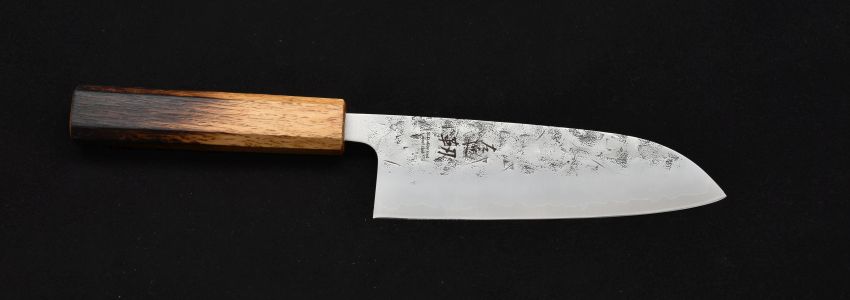
There are several reasons to choose a knife from Shinzuke Hokiyama. Its production and technological capabilities are among the most significant in all of Japan, thanks to its equipment and craftsmanship. You can find its blades not only at knife makers in Tosa, but also in Sakai, Seki, Fukuyama and of course in fancy shops all over Japan. The range of materials, production methods and finishing textures is so extensive that the choice itself is not easy at all.
We have the honor to present you another edition from the Hokiyama line, the Sakon Jin Washiji. The name itself says a lot. Jin means solid in translation. And that's exactly what the blade is. It is a three-layer San Mai construction with an ultra-hard core and softer layers on the sides. The core was supplied by Hitachi Metals steelworks in the form of SLD tool steel. Thanks to the high carbon content /1.5%/ and good hardenability supported by manganese, a hardness of up to 64 HRC was achieved. Hardness defines the durability of the blade and resistance to abrasion. However, it is often in contrast to strength. But this is not the case. The molybdenum content reduces brittleness and vanadium and silicon contribute to strength. 12% chromium classifies SLD as semi-stainless materials, and therefore it is recommended to keep the blades dry after use. However, oil treatment is not necessary thanks to the anti-corrosion outer layers of softer SUS405 steel, which give the blade the necessary complexity and balance of properties.
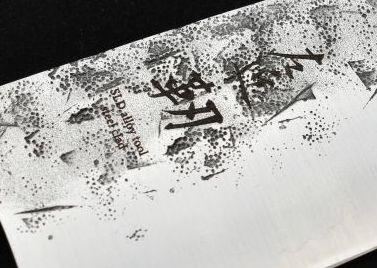
We have finished the material side, let's move on to the aesthetic side, which is equally interesting. The upper part of the blade has a distinctive Washiji texture, reminiscent of handmade washi paper. The shinogi is subtly matte and smoothly transitions into a polished hamon. The blade literally "plays" at different angles of light. The right side bears the kanji characters of the name Sakon Jin and the designation of the steel core.
Another reason why we like Hokiyama knives is their edge. This manufacturer has some of the best sharpeners in the industry. They can create a razor-sharp edge, but without compromising on its durability. In this particular case, it is a symmetrical "V"-shaped edge. We still have the handle. Yes, only the handle, since the manufacturer chose a minimalist variant without a ferrule. We accept the choice. The typical half tang is mounted in an octagon made of annealed oak wood. The result is a decent and functional-looking unit that will amaze you with its performance.
©2025 Copyright Roman Ulík, Nippon Knives,www.japonskenoze.sk all rights reserved.
Photos and texts are protected by copyright law and their use without the author's consent is not possible.