Sign in
 Registration


Product detail
There are several reasons to choose a knife from Shinzuke Hokiyama. Its production and technological capabilities are among the most significant in all of Japan, thanks to its equipment and craftsmanship. You can find its blades not only at knife makers in Tosa, but also in Sakai, Seki, Fukuyama and of course in fancy shops all over Japan. The range of materials, production methods and finishing textures is so extensive that the choice itself is not easy at all.
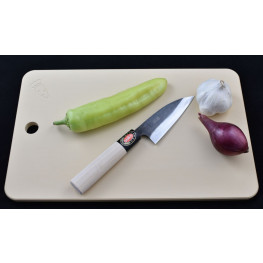
We have the honor to present you another edition from the Hokiyama line, the Sakon Jin Washiji. The name itself says a lot. Jin means solid in translation. And that's exactly what the blade is. It is a three-layer San Mai construction with an ultra-hard core and softer layers on the sides. The core was supplied by Hitachi Metals steelworks in the form of SLD tool steel. Thanks to the high carbon content /1.5%/ and good hardenability supported by manganese, a hardness of up to 64 HRC was achieved. Hardness defines the durability of the blade and resistance to abrasion. However, it is often in contrast to strength. But this is not the case. The molybdenum content reduces brittleness and vanadium and silicon contribute to strength. 12% chromium classifies SLD as semi-stainless materials, and therefore it is recommended to keep the blades dry after use. However, oil treatment is not necessary thanks to the anti-corrosion outer layers of softer SUS405 steel, which give the blade the necessary complexity and balance of properties.
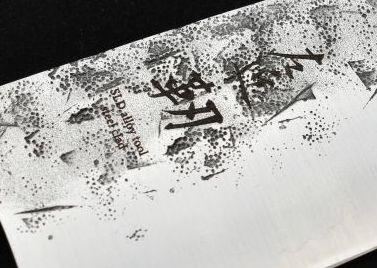
We have finished the material side, let's move on to the aesthetic side, which is equally interesting. The upper part of the blade has a distinctive Washiji texture, reminiscent of handmade washi paper. The shinogi is subtly matte and smoothly transitions into a polished hamon. The blade literally "plays" at different angles of light. The right side bears the kanji characters of the name Sakon Jin and the designation of the steel core.
Another reason why we like Hokiyama knives is their edge. This manufacturer has some of the best sharpeners in the industry. They can create a razor-sharp edge, but without compromising on its durability. In this particular case, it is a symmetrical "V"-shaped edge. We still have the handle. Yes, only the handle, since the manufacturer chose a minimalist variant without a ferrule. We accept the choice. The typical half tang is mounted in an octagon made of annealed oak wood. The result is a decent and functional-looking unit that will amaze you with its performance.
©2025 Copyright Roman Ulík, Nippon Knives,www.japonskenoze.sk all rights reserved.
Photos and texts are protected by copyright law and their use without the author's consent is not possible.
About producer
Tosa is the ancient name of today's Kochi Prefecture, which is located in the southern part of the island of Shikoku. The north of the prefecture is made up of inhospitable mountains, which towards the south pass into a fertile plain filled with countless rice fields. They are protected from possible tsunami waves by barriers built on the beaches of the Pacific Ocean. Connoisseurs of Japanese blacksmithing will not call this area anything other than Tosa.
For more than 800 years, the interlaced steel made famous by samurai swords has been forged in Tosa. It can be said that this area has become a kind of "open-air museum" of traditional blacksmithing. You will find small workshops scattered here, in which individual family generations create gems that are incomprehensible to us. It is almost a rule that father and son work in the workshop to ensure the continuity of the tradition. All kinds of blades are made here, from agricultural tools to rare knives, but in a diametrically different way than in the Seki, Sakai, or Tsubame/Sanjo areas. Knives intended for decoration were never produced here, but durable work tools. That is why knives from Tosa are sought after by connoisseurs all over the world.
Since 1919, the Hokiyama Cutlery company has been among the pioneers in improving the traditional production of kitchen knives. In accordance with the motto "the good must be preserved and, if possible, also improved", Shinsuke Hokiyama created 3 lines in his company: traditional, practical and innovative.
The traditional line /Tosa-Ichi/ consists of hand-forged blades from such masters as Takeo Murata. It is a layered steel, the core of which is high-carbon shirogami or aogami type steel. Hitachi Blue Super is used for the best pieces. The blades are most often in the unpolished form of kurouchi. Knives require care, as this material is not anti-corrosive. The practical line /Sakon/ is a symbiosis of traditional production procedures with modern materials and design. In addition to high-carbon steel, very hard powder tool steel and damascene steel are also used. Emphasis is placed on precisely processed and ergonomically tuned handles. The innovative line /Mugen/ is the pride of Hokiyama Cutlery. It adopts advances from other fields into the production of its knives. These are mainly self-sharpening knives SAKON+ with the patented Vee-Tech technology taken from the aviation and space industry.
Friendly relations with the owner of Hokiyama Cutlery, Mr. Shinsuke Hokiyama, enabled us to gradually bring you the most interesting knives from the legendary Tosa region.
©2010-2018 Copyright Roman Ulík, Nippon Knives, www.japonskenoze.sk all rights reserved.
Photos and texts are protected by copyright law and their use without the author's consent is not possible.