Sign in
 Registration


Product detail
The Grand Chef series of knives from the renowned manufacturer Sakai Takayuki immediately found its die-hard fans, especially among professional chefs. No wonder. It is a lightweight knife with an ultra-sharp blade that holds its edge for an incredibly long time. Add to that excellent corrosion resistance, good sharpenability and you have the ideal tool in the world. So how about raising the bar even higher?
What is good does not change, it applies everywhere, but especially in Japan. The lightweight half tang construction remains preserved, as does the use of foreign steel. To increase attractiveness, work was done on aesthetics. The choice fell on the Damascus composition. It consists of 45 layers, which create patterns reminiscent of hamon with differentiated hardening. Hence the name Grand Chef HAMON. The core Sakay Takayuki called Bohler SP Steel. It is a modern N685 steel from the manufacturer of the same name. Thanks to the high carbon content and abundant presence of chromium, manganese, vanadium and silicon, the material excels in abrasion resistance and anti-corrosion, while still maintaining decent strength. Layers of softer and harder stainless steel alternate on the sides. The blade edge is symmetrical.
The proven octagonal handles are made of rosewood. It is not only striking in its color, but also in its texture. You get the feeling that the ripples from the blade flow smoothly into the handle. The closed ferrule made of stabilized pakkawood wood is used to emphasize the contrast in black.
Grand Chef Hamon knives may be a few grams heavier than their basic version, but if you are looking for added value in the form of aesthetic design, you have come to the right place.
©2025 Copyright Roman Ulík, Nippon Knives, www.japonskenoze.sk all rights reserved.
Photos and texts are protected by copyright law and their use without the author's consent is not possible.
About producer

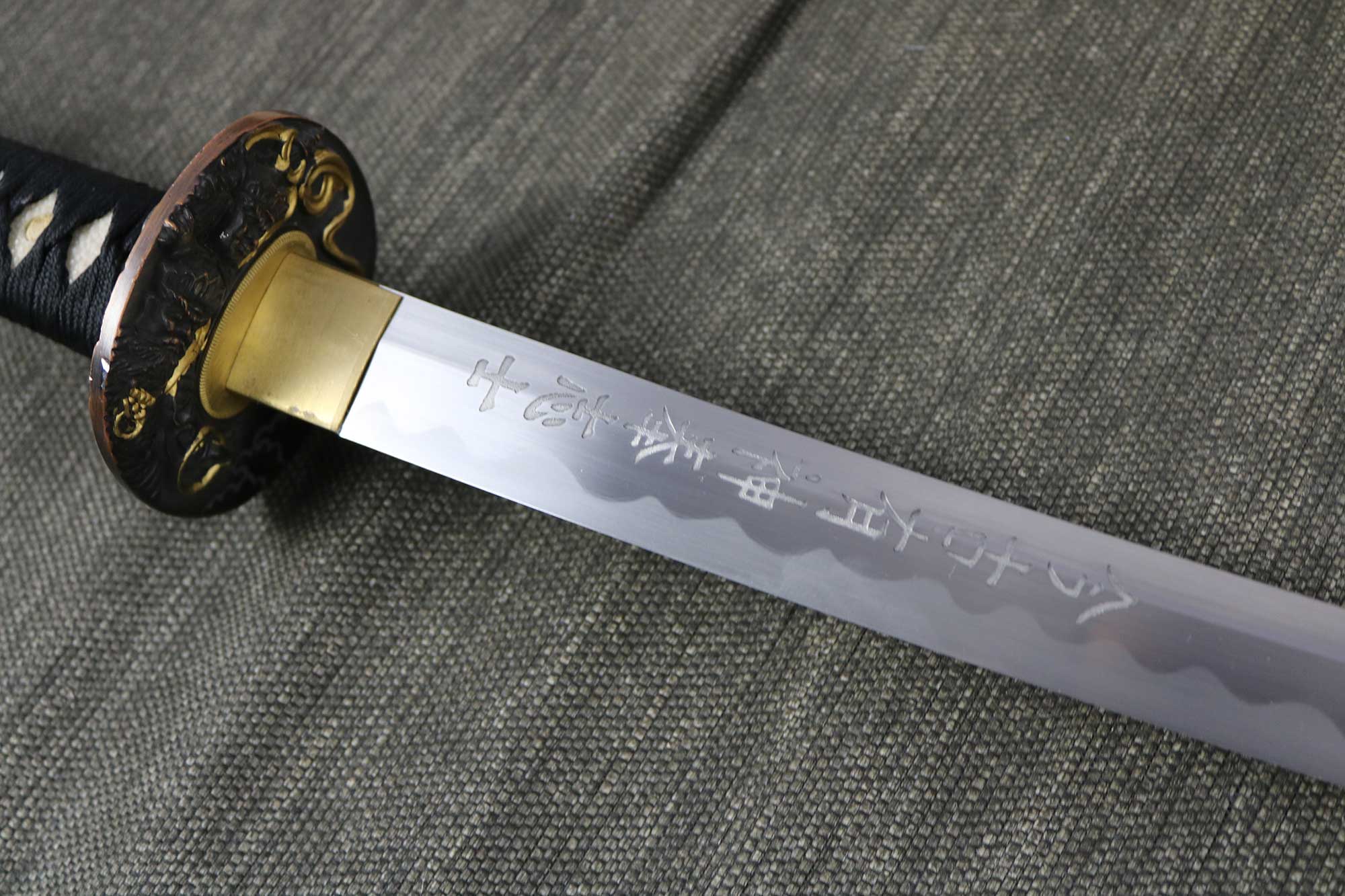
Sword – a symbol of ancient Japan. It is no coincidence that it forms one of the imperial insignia. It is a Kusanagi sword and its core was also created by multiple folding and forging of the highest quality steel. Thanks to many generations of talented craftsmen, this proven method of producing hard and tough material has been preserved to this day. This is how knives were created that have no parallel in the world.
Sakai, or the city of knives, is today a western suburb of Osaka. The city experienced its greatest development in the 16th century, when it was one of the busiest commercial centers. The latest technologies from all over the world as well as different cultures met here. This helped the development of blacksmithing techniques, which had already reached a high level thanks to the production of traditional swords. The Portuguese brought the first rifles to the area and Sakai blacksmiths changed the production program. But since it was a period of peace, they mainly produced decorative rifles. With the boom in tobacco, they smoothly transitioned to the production of knives for cutting tobacco, but the mechanization of its processing resulted in another production change. Blacksmiths began to specialize in the production of kitchen knives. It was also influenced by the proximity of another important city - Kyoto. It is characterized by its culinary art, and the preparation of individual dishes requires special knives. Today, the majority of Japanese chefs use knives made in the city of Sakai.
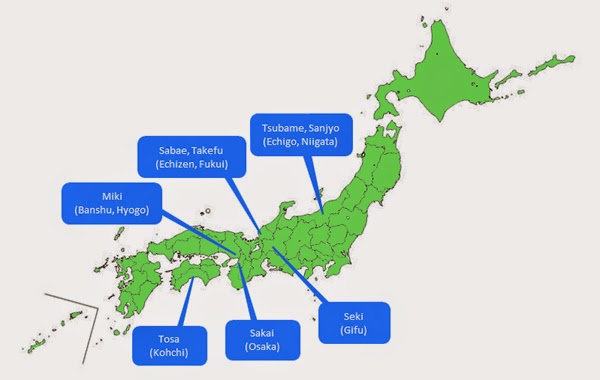

Sakai has a slightly shorter history compared to Seki, but nowadays it is their meaning comparable. The difference is mainly in the production program. In Seki, the production of Western-style Japanese knives prevails, with a strong emphasis on export. Manufacturers in Sakai, on the other hand, specialize mainly in traditional Eastern-type knives. Their clientele consists mainly of Japanese professional chefs.

Mr. Takayuki became famous for consolidating the Sakai blacksmiths in 1946. He provided them with production facilities and tools and thus founded the Sakai Takayuki brand. It is currently being looked after by the 3rd generation of this family. The brand is owned by Aoki Hamono, which in 2006 won the prestigious Sakai Wazashu award for the skill of local manufacturers.
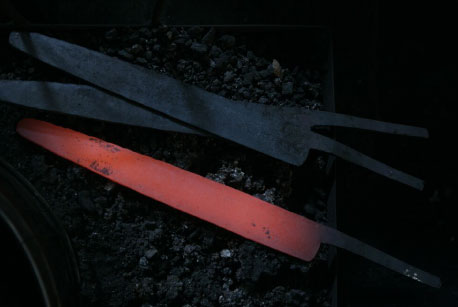
The potential of the Aoki Hamono company lies in key personnel positions, which are blacksmith and grinder. Masters with high awards and with experience exceeding 50 years in some cases work here.
Keijiro Doi - blacksmith
At the age of 19, he took the place of his father, a prominent blacksmith, in the workshop. In 1987, he was certified by the Ministry of International Trade and Industry as a Blacksmith Master. In 1997, he received the Green Paulownia Leaves award.
Yukinori Oda – grinder
He is a holder of the Sacred Treasure order, Silver Rays. Already at the age of 20, he became a master. He sticks to his motto: "The sharpness of a good knife is 100%." However, the role of the grinder is to increase it to 120%."
Suogo Yamatsuka - blacksmith
He constantly pushes the boundaries of perfection. He specializes in Gingami 3 anti-corrosion steel.
Hirotsugu Tosa – grinder
He was born in 1948 and trained as a grinder at the age of 18. In 1991 he achieved the title Sharpener Master. He knows no compromises in his work because he is constantly thinking about the users of his knives.
Itso Doi - Blacksmith
Son of Master Keijiro. It represents the third generation of the clan. He is best placed to preserve this championship for generations to come.
Mitsuo Yamatsuka – grinder
In 1999, he received the Japanese Traditional Craftmanship certificate. It is a guarantee that a traditionally forged knife will acquire "Sakai" sharpness.
Due to the handmade production and the huge interest among professionals in Sakai knives, it is quite difficult to obtain at least a few pieces. Our efforts and patience finally brought us the honor of introducing you to products in which the soul of their makers resides. Welcome to Sakai!
Video from the workshop
©2019 Copyright Roman Ulík, Nippon Knives, www.japonskenoze.sk all rights reserved.
Photos and texts are protected by copyright law and their use without the author's consent is not possible.