Sign in
 Registration


Sanpou-Mizu
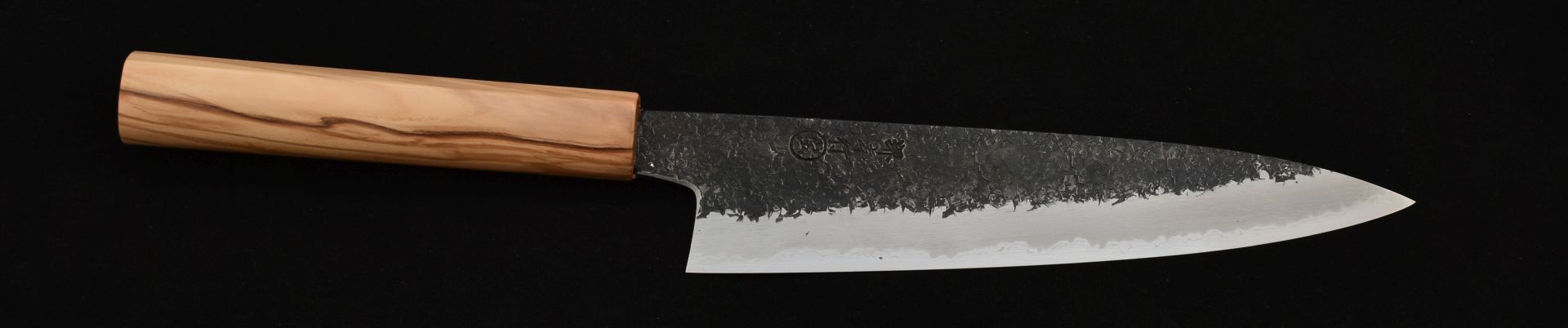
The neighbourhood in Sakai where the Aoki Hamono (Sakai Takayuki) workshops are located is called Sanpou. It is a Buddhist name meaning ‘three treasures’. The three treasures of Buddhism are the Buddha, his teachings and his followers. Blacksmiths, too, have their own three treasures: iron (Tetsu), water (Mizu) and fire (Hi). It was here that the idea arose to create the Sanpou series, comprising the three treasures of blacksmithing in the form of hand-forged collections: Mizu, Tetsu and Hi.
Water plays a vital role in blacksmithing. Although water quenching is the most demanding method, it produces the hardest material. That is why it rightly ranks among the three treasures of blacksmithing. So let’s take a look at this gem, which has arrived at the Nippon Knives shop.
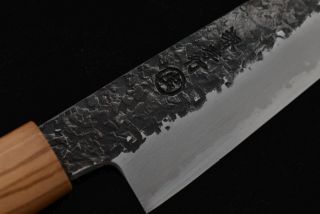 The master craftsmen at Aoki Hamono specialise in Awase-style blades (Ni Mai and San Mai). In this case, it is a hand-forged, three-layer San Mai blade. The core is forged from ‘white’ Shirogami 2 steel, which, thanks to its hardness, holds its edge beautifully. It is a very pure steel, and to minimise the maintenance required for the knife, the outer layers are made of a corrosion-resistant material. This means that only the cutting edge itself needs to be treated with oil. It is symmetrical in shape, forming a wide ‘V’ with a convex tip. The upper section (Hira) features a Kurouchi finish with hand-hammered Tsuchime. The Kireha is matt sandblasted, and its interface with the polished core resembles Hamon. However, as this is an Awase-type blade, the more accurate term is ‘clad line’ (the interface between the layers). A blade like this would not be complete without kanji markings. On the right-hand side is a stamped circle representing the Tsuba, with the character for ‘Mizu’ inside it. This is followed by the Sakai Takayuki mark. On the left-hand side is the name of the core material – White 2 Steel (Shirogami 2).
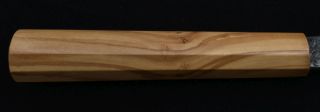 The knife is beautifully complemented by its olive wood handle. As well as its attractive colour and grain, its shape is particularly striking. It is square in cross-section, tapering smoothly into a curve at the bottom. It provides a comfortable and secure grip. The Sakai masters’ attention to detail is evident in the woodcarving of the kanji character ‘Mizu’ on the end of the handle. We welcome the absence of a ferrule.
Alongside the Homura Guren, the Sanpou – Mizu is one of Sakai Takayuki’s top-of-the-range Awase knives. We are already looking forward to more treasures from the blacksmith’s forge.
©2026 Copyright Roman Ulík, Nippon Knives, www.japonskenoze.sk all rights reserved.
The photographs and texts are protected by copyright law and may not be used without the author’s consent.