Sign in
 Registration


Product detail
Those of you who have had the chance to take a peek ‘behind the scenes’ at a Chinese restaurant will certainly agree that it is an extraordinary experience. The intensity with which work is carried out in such a relatively small space is truly breathtaking. For the Chinese, as for other Asians, productivity is a defining factor. As well as the chefs and their assistants with their swift movements, the abundance of steam, noise and, above all, exotic aromas, you’ve no doubt noticed the many bamboo steamer baskets and ‘oversized’ conical pans, which have gained popularity worldwide under the name ‘wok’. But surely one particular contraption, which from a distance resembles a square table tennis bat, will not have escaped your attention. The chef rarely lets this contraption out of his hands. In a flash, he uses it to slice vegetables into fine strips, chop herbs into tiny pieces, grind peanuts into a powder, crush garlic and cut meat into even pieces. With a graceful movement, like a croupier at a roulette table, he scoops everything up with the wonder and tosses it into the steaming wok. It is no coincidence that this wonder has earned the official name ‘Chinese chef’s knife’. You may sometimes come across the term ‘Chinese knife’, which we strongly object to. A ‘Chinese knife’ is any knife made in China. We, however, are talking about a type of knife made in Japan. And that is a huge difference.
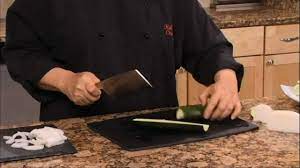
It would be a big mistake to confuse this tool with a meat cleaver. At first glance, they look quite similar, but they serve very different purposes. Both have a wide, square blade, but the meat cleaver is in a different weight category. Similarly, its blade is designed to cut through meat, tendons, cartilage and smaller bones using pressure.
A Chinese chef’s knife is considerably lighter and, above all, it is a knife. This means that we use it to cut with a pulling motion, not by applying pressure. Its blade is therefore more delicate. The Chinese chef’s knife from the Japanese brand Mcusta Zanmai has a 180mm-long blade with a symmetrical edge, measuring 90mm at its widest point. It is handy even for those with little experience of this type of knife, yet large enough for comfortable scooping. It is made from stainless Damascus steel. Thirtytwo layers of alternating steel of varying hardness surround a VG10 core hardened to 61 HRC. The result is high aesthetic appeal and uncompromising cutting performance. The handle, made from stabilised Pakkawood, fits comfortably in the hand. This is thanks to the hexagonal shape, which flows smoothly into a rounded profile. The exclusive guard is made from a nickel and silver alloy. Weighing 360g, it is a pleasant surprise given its size. You certainly won’t be peeling potatoes with this knife, but there are indeed many tasks it can handle with surprising ease.
©2026 Copyright Roman Ulík, Nippon Knives, www.japonskenoze.sk all rights reserved.
Photographs and texts are protected by copyright law and may not be used without the author’s consent.
About producer
Marusho Industry Inc. - a company producing refined Mcusta pocket knives, luxurious Zanmai kitchen knives and iconic Silky scissors - located in the center of Japanese cutlery, in the city of Seki. The city gained this status already in the middle of the 13th century thanks to sand with a rich content of iron ore, high-quality peat and water sources. These were the reasons why the renowned sword maker Motoshige relocated to this area from the island of Kyushu. During the Muromachi period (1338-1573), more than 300 blacksmiths worked in Seki. Among the most famous were Kanemoto Magoroku and Saburo Shizu. Seki swords quickly gained a reputation throughout Japan.
The Marusho company was founded in 1964. Today, it is run by the founder's grandson and his family. It operates one of the most advanced knife factories not only in the city of Seki, but in all of Japan. Thanks to advanced technologies (laser cutters, CNC mills, 3D CAD/CAM projection), the company produces products refined to the smallest detail. The best example is Zanmai brand kitchen knives. But without manual finalization by experienced craftsmen, the products would be far from perfect.
Zanmai means Luxury in Japanese. However, the word is actually derived from the Sanskrit "Samadhi", which is the term for the process of meditation leading to consciousness. It is not known how deeply the Hasegawa clan devotes itself to meditation, but this matter is more than clear. Their knives are consciously polished to the highest luxury.
©2010-2018 Copyright Roman Ulík, Nippon Knives, www.japonskenoze.sk all rights reserved.
Photos and texts are protected by copyright law and their use without the author's consent is not possible.