Sign in
 Registration


What material is used for the handles of Japanese knives?
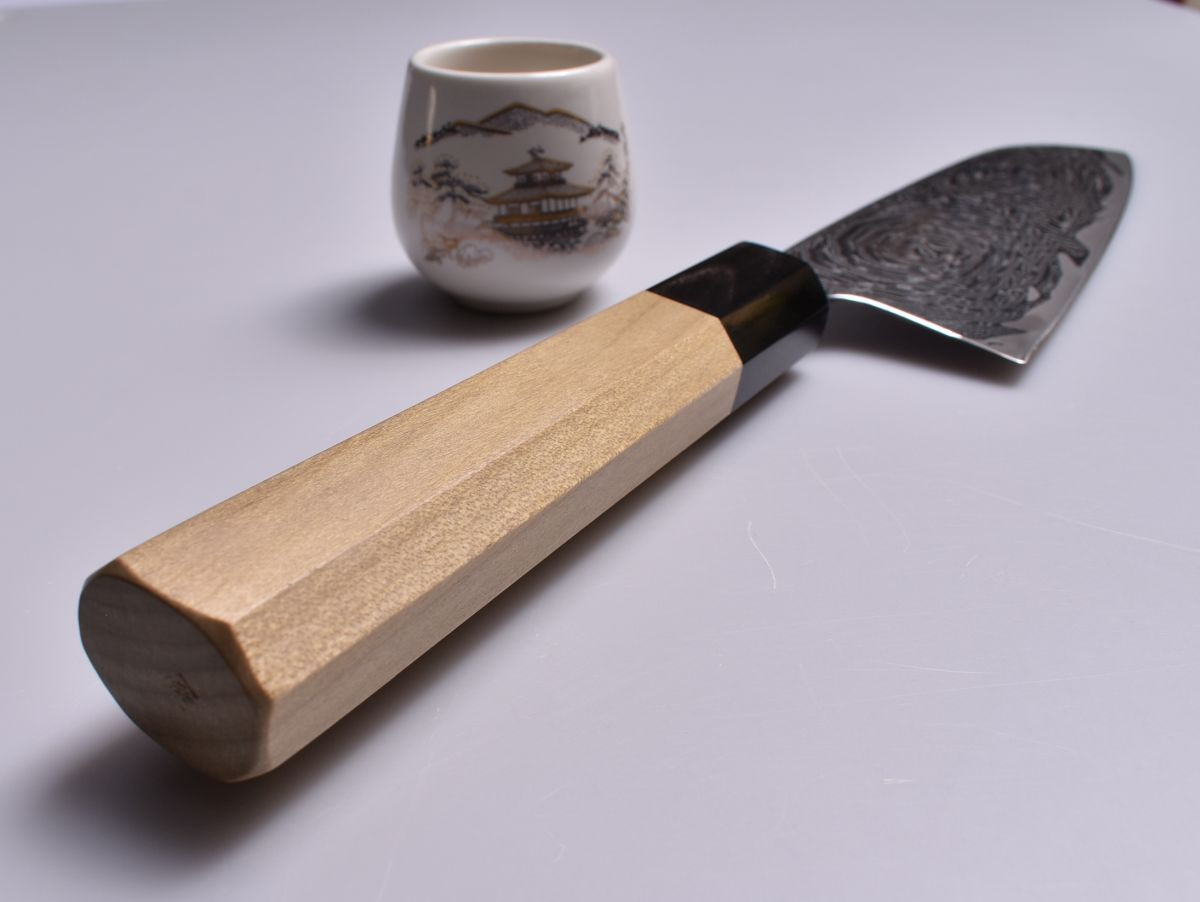
A knife cannot fulfill its primary function without a quality handle. The handle must be strong, ergonomic and should complement the knife aesthetically. And Japanese manufacturers really dominate in this. Let's forget about the shape of the handles and talk about the individual materials that we most often encounter.
Solid wood
Many Japanese knives, especially those with typical half tang designs, have solid wood handles. The most commonly used are magnolia, oak, walnut, chestnut, cherry, bamboo, hinoki, hornbeam, rosewood, teak, wenge, ebony... These woods are great for traditional Japanese knives (Wa Bocho) and increase their aesthetic value.
Stabilized wood (Stamina)
A thermosetting resin is applied to the wood, which is then hardened at high temperature or chemically. The result is a hard and durable material that, thanks to the approximately 70% share of wood itself, looks warm, aesthetic and natural. The wood retains its texture and color. This can be enhanced by adding pigment.
Pakkawood
The source wood is cut into thin veneers. These are coated with thermosetting resin and layered to the required thickness (most often from 16mm to 45mm). Such a composite is placed in a press and exposed to high temperature, at which the thermosetting resin hardens. At the end of this process, the wood is compressed, which is resistant to twisting and cracking. It resists moisture and temperature very well and has dimensional stability. The proportion of high-quality wood is about 70%. Pigment can be added to enhance the effect.
Micarta
A composite consisting of thermosetting resin (60%) and cotton, linen or jute fabric (40%). Again, pressure and high temperature, necessary for curing the resin, come into play. Micarta is very hard and strong, but at the same time it is easy to process. The highest quality ones can withstand temperatures up to 210°C. The canvas and pigments used determine the final appearance of the material.
Acrylic
Polymethyl methacrylate is a transparent plastic. It is used as a substitute for glass wherever mechanical resistance and dielectric strength are required. It is a non-toxic material that allows for the creation of very imaginative shapes and color combinations. The material is recyclable.
Artificial marble
It is an advanced composite material made of a mixture of crushed minerals and resin. In addition to strength, impact resistance and moisture resistance, the absence of pores is an important property. Artificial marble is therefore very hygienic and finds its place in professional operations focused on a high level of hygiene. It is very easy to process. There are several brands based on this composite, such as Corian, Krion, Juma... The material is recyclable.
Carbon
Carbon fibers are covered with epoxy resin and then bonded under high pressure. The resulting material is hard, strong (5 times stronger than steel) and very light. It is mainly used on professional and sports knives. It does not corrode and has a long service life. The energy and technological complexity of production makes it an expensive material.
G10
Glass fibers are impregnated with epoxy resin. The material hardens at high pressure. It withstands high temperatures and humidity. It is dimensionally stable and easy to process.
Steel
Exclusively stainless steel is used. Its advantage is strength and toughness. Steel handles have a long service life and their maintenance is negligible. All-metal structures are suitable for lovers of heavier knives. The more luxurious ones have a Damascus structure.
Aluminum
Although aluminum itself is soft, its alloys, such as Dural, are strong, light, dimensionally stable and can be processed very well. Various surface treatments such as anodizing increase the already good resistance to moisture. They are most often used on sports knives.
Titanium
Although it does not stand out in hardness, it is a champion in the weight-to-strength ratio. It is excellently resistant to corrosion and heat, and as a tough material, also to stress. Some manufacturers increase the hardness of titanium by coating it with DLC (Diamond like carbon). It is very expensive and is therefore used on high-end knives.
Metal/leather
The most traditional knives refer to the famous Japanese swords in their construction. The steel core of the handle is covered with ray skin and then wrapped with a leather bandage (Tsukamaki). With original brands, it is never an imitation, but natural materials.
All these materials used on original Japanese knives are certified for contact with food.
Here are a few examples from our offer.
- magnolia, oak, walnut, chestnut, cherry, bamboo, hinoki, ironwood, maple, rosewood, teak, wenge, ebony
- micarta
- acrylic
- carbon
- steel
- aluminum
- titanium
- DLC